ChatGPT vs Claude 3.5: The Ultimate Comparison
In this detailed comparison, we put two of the most powerful AI assistants head to head — OpenAI’s ChatGPT powered by GPT-4o and Anthropic’s Claude 3.5 Sonnet. Both tools have matured significantly throughout 2025 and into 2026, each carving out distinct strengths and loyal user bases. If you are trying to decide which AI assistant deserves your subscription dollars, this detailed breakdown will help you make an informed choice.
We tested both tools across hundreds of prompts spanning five major categories: writing quality, coding ability, analytical reasoning, creative tasks, and general knowledge. Here is what we found.
Writing Quality
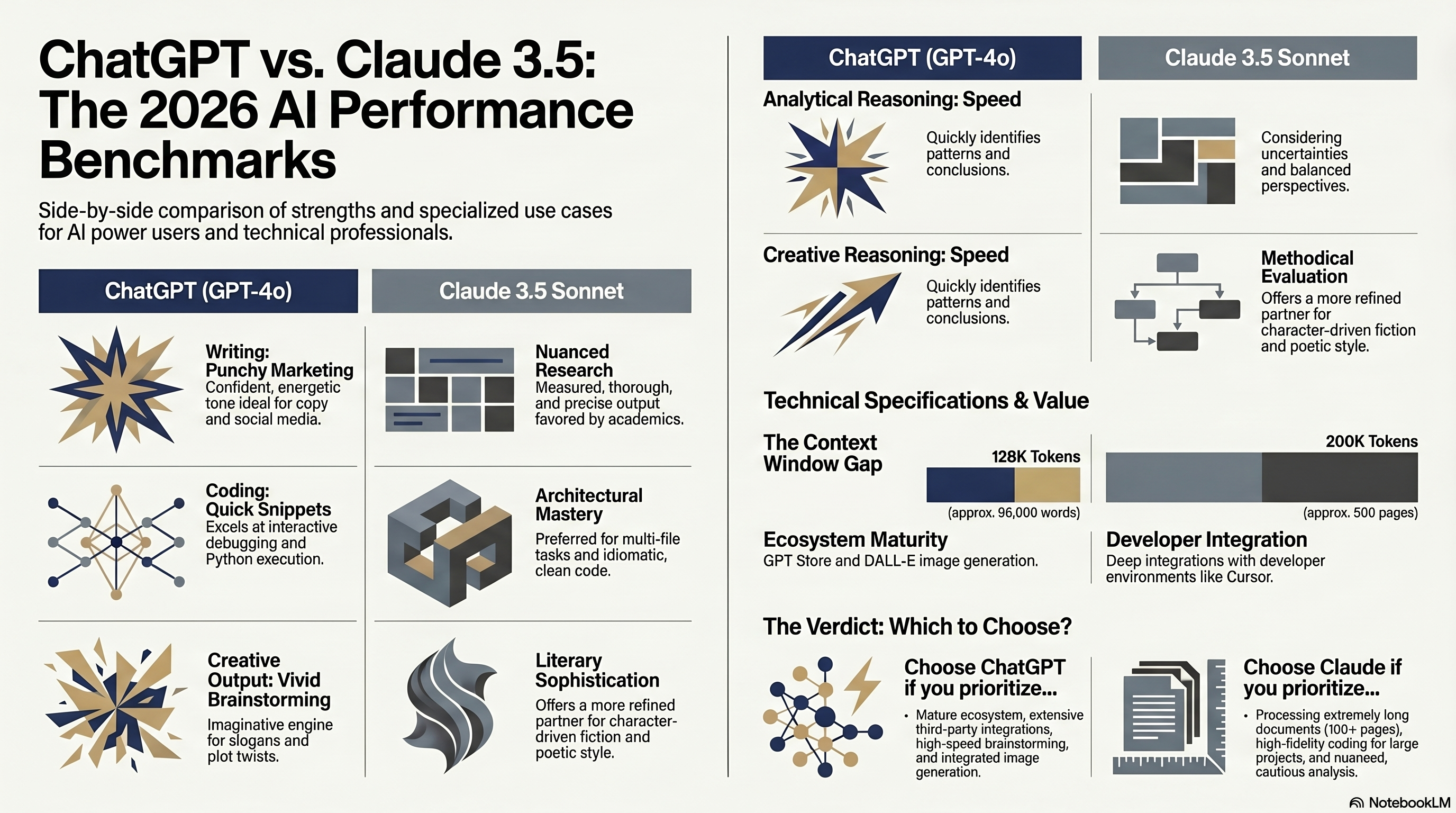
When it comes to writing, both ChatGPT and Claude deliver impressive results, but they have noticeably different styles. ChatGPT tends to produce content with a confident, energetic tone. Its output is polished and reads well out of the box, with strong paragraph structure and natural transitions. It excels at marketing copy, social media content, and persuasive writing where a punchy, engaging style is desirable.
Claude, on the other hand, produces writing that is more measured, nuanced, and detailed. Its output tends to be longer and more thorough, with careful attention to caveats and balanced perspectives. Academic writers, researchers, and professionals who need precision over flair often prefer Claude’s writing style. Claude also demonstrates superior ability to maintain a consistent voice across very long documents, thanks in part to its larger context window.
For short-form marketing content, ChatGPT has a slight edge. For long-form articles, reports, and documentation, Claude generally produces more refined and thorough output. Both tools handle professional email drafting, blog writing, and social media posts with excellent quality.
Coding Ability
Coding is one area where both tools have made tremendous strides. ChatGPT with GPT-4o is an excellent coding assistant that handles a wide range of programming languages including Python, JavaScript, TypeScript, Rust, Go, and many more. It excels at generating boilerplate code, debugging errors, explaining complex algorithms, and refactoring existing code. The integration with Code Interpreter allows ChatGPT to actually execute Python code and return results, which is invaluable for data analysis tasks.
Claude 3.5 Sonnet has earned a particularly strong reputation among developers for its coding capabilities. Many professional developers report that Claude produces cleaner, more idiomatic code with better error handling out of the box. Claude’s larger context window is a significant advantage when working with large codebases — you can paste entire files or even multiple files and ask Claude to analyze, refactor, or extend them.
In our testing, Claude performed slightly better on complex multi-file coding tasks and architectural decisions, while ChatGPT excelled at quick code snippets and interactive debugging sessions. Both tools are excellent coding assistants, and the best choice often comes down to your specific workflow preferences.
Analytical Reasoning
Both AI assistants demonstrate strong analytical capabilities, but they approach analysis differently. ChatGPT is quick to identify patterns, make connections, and present conclusions in a clear, structured format. It works well for business analysis, market research summaries, and data interpretation tasks where speed and clarity are priorities.
Claude tends to be more methodical in its analysis. It often considers multiple perspectives, acknowledges uncertainties, and provides more cautious, well-reasoned conclusions. For tasks that require careful evaluation of evidence — such as legal analysis, scientific literature review, or policy evaluation — Claude’s thoroughness is a distinct advantage.
When we tested both tools with complex reasoning problems, including logic puzzles, mathematical proofs, and multi-step analytical tasks, they performed comparably overall. ChatGPT was slightly faster at arriving at answers, while Claude was slightly more accurate on problems that required careful step-by-step reasoning. For most practical analytical tasks, either tool will serve you well.
Creative Tasks
Creativity is a fascinating dimension to compare. ChatGPT brings an enthusiastic, imaginative energy to creative tasks. It generates vivid storylines, catchy slogans, and inventive ideas with impressive speed. Its brainstorming capabilities are particularly strong — ask for 20 business name ideas or 10 plot twists, and ChatGPT delivers creative, diverse suggestions quickly.
Claude approaches creativity with a more literary sensibility. Its creative writing tends to be more subtle, character-driven, and stylistically sophisticated. Claude is particularly adept at mimicking specific writing styles, maintaining consistent character voices in fiction, and producing poetry that demonstrates genuine artistic awareness. Writers working on novels, short stories, or screenplays often find Claude’s creative output more usable and authentic.
For advertising and marketing creativity, ChatGPT generally produces more immediately impactful ideas. For literary and artistic creative work, Claude offers a more refined and nuanced creative partner. Both tools are capable of producing excellent creative content, and many professionals use both depending on the specific creative challenge at hand.
Context Window and Memory
This is where one of the most significant differences emerges. Claude 3.5 Sonnet offers a 200K token context window, which translates to roughly 150,000 words or approximately 500 pages of text. This massive context capacity means you can feed Claude entire books, lengthy research papers, complete codebases, or extensive document collections and have it work with all of that information simultaneously.
ChatGPT with GPT-4o provides a 128K token context window, which is still very generous at roughly 96,000 words. For most everyday tasks, this is more than sufficient. However, for specialized use cases like analyzing entire legal contracts, processing lengthy manuscripts, or working with large codebases, Claude’s larger context window provides a meaningful advantage.
Both tools can sometimes lose track of earlier context in very long conversations, but Claude generally demonstrates better recall and consistency throughout extended interactions. If your work regularly involves processing or producing very long documents, Claude’s context window advantage is worth considering.
Pricing and Value
As of early 2026, ChatGPT Plus is priced at $20 per month, giving you access to GPT-4o with generous usage limits, DALL-E image generation, Code Interpreter, and the ability to create custom GPTs. The free tier provides access to GPT-4o with lower rate limits, making it accessible to casual users.
Claude Pro is also priced at $20 per month, offering significantly higher usage limits for Claude 3.5 Sonnet, priority access during peak times, and early access to new features. The free tier provides access to Claude 3.5 Sonnet with moderate rate limits.
Both subscriptions offer excellent value at the same price point. The deciding factor should be which tool’s strengths align better with your primary use cases rather than pricing. Many power users maintain subscriptions to both services, using each for the tasks where it excels.
Integration and Ecosystem
ChatGPT benefits from a more mature ecosystem. The GPT Store offers thousands of specialized custom GPTs, the API is widely integrated into third-party applications, and plugins extend ChatGPT’s functionality into web browsing, data analysis, and more. OpenAI’s brand recognition also means that ChatGPT integrations are available in more productivity tools and platforms.
Claude’s ecosystem is growing rapidly. Anthropic has forged partnerships with major platforms, and the Claude API is gaining traction among developers. Claude’s integration with tools like Cursor and various IDE extensions has made it particularly popular in the developer community. While the ecosystem is not as extensive as ChatGPT’s yet, the quality of Claude’s integrations is generally very high.
Safety and Ethics
Both companies take AI safety seriously, but their approaches differ. OpenAI uses reinforcement learning from human feedback to align ChatGPT’s behavior and has implemented various safety guardrails. Anthropic, founded by former OpenAI researchers, has developed its Constitutional AI approach, which trains Claude to be helpful, harmless, and honest using a set of defined principles.
In practice, Claude tends to be slightly more cautious and transparent about its limitations. It is more likely to acknowledge when it is unsure about something and to present balanced perspectives on controversial topics. ChatGPT has become more nuanced in its responses over time and generally handles sensitive topics with appropriate care. Both tools are safe and responsible choices for professional use.
Our Verdict
There is no single winner in this comparison — the best tool depends on your specific needs. Choose ChatGPT if you prioritize a mature ecosystem with extensive integrations, prefer a confident and engaging writing style, need image generation capabilities, or want access to thousands of custom GPTs. Choose Claude if you work primarily with long documents, value careful and nuanced analysis, need superior coding assistance for large projects, or prefer a more measured and thorough communication style.
The best news for consumers is that competition between these two platforms continues to drive rapid improvement on both sides. Whichever tool you choose, you are getting access to some of the most powerful AI technology ever created, at a price point that would have seemed impossibly low just a few years ago. Many professionals find that maintaining subscriptions to both services is a worthwhile investment, using each tool for the tasks where it truly excels.